Research
Research
My research develops AI-assisted, physics-informed, and optimization-based methods for resilient energy systems. The goal is to help operators prepare for disturbances, evaluate candidate actions before deployment, and preserve critical services during outages, cyber-physical events, and rapid large-load growth.
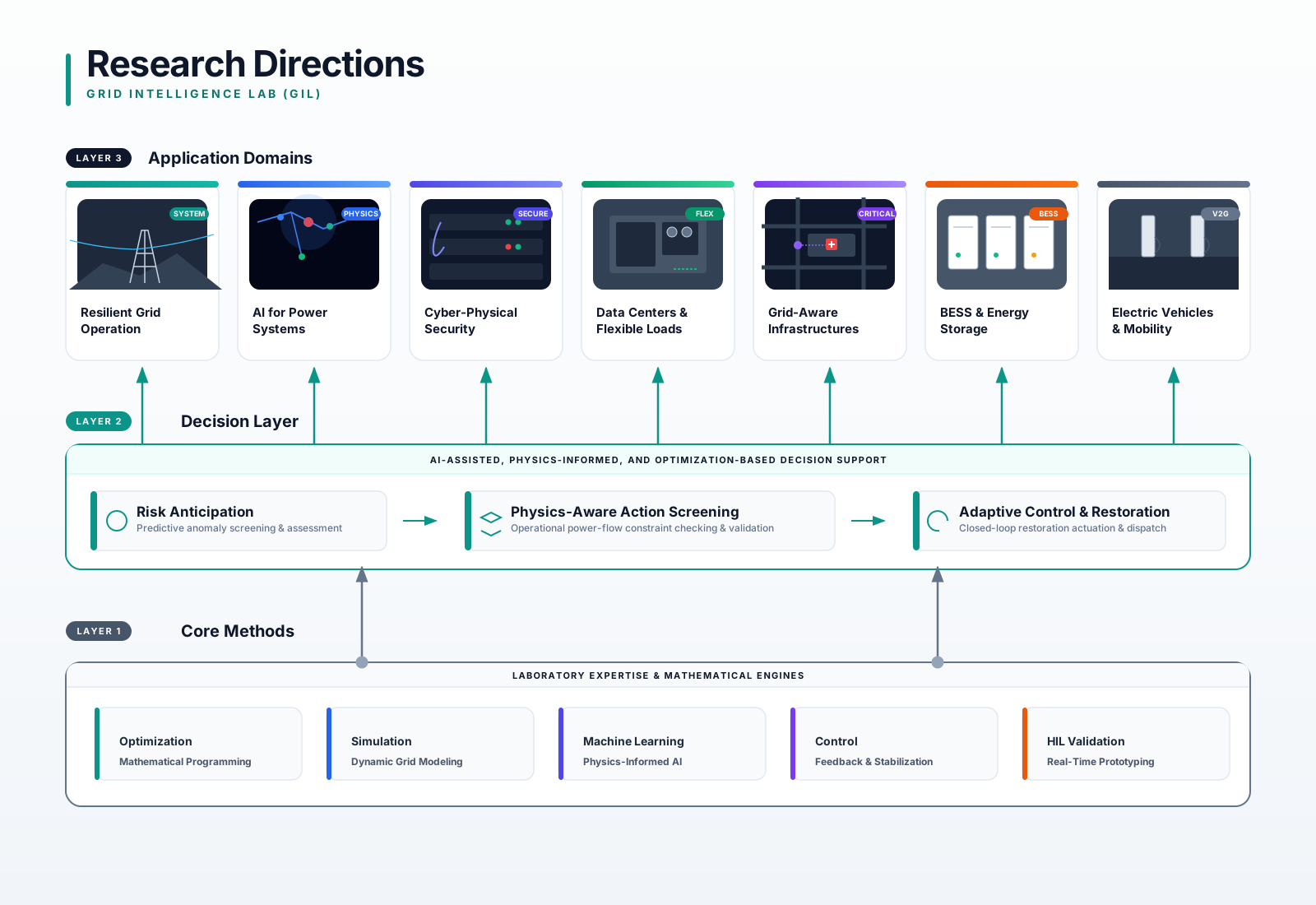
Research pillars
1. Resilient grid restoration
Optimization and safe control for outage mitigation, dynamic restoration, blackstart-compatible resources, and microgrid recovery.
2. AI for power-system operation
Safe reinforcement learning, model-predictive control, physics-informed learning, and LLM-assisted operator decision support.
3. Cyber-physical security
Detection and mitigation of false-data injection, load-altering, topology, and communication-driven attacks in active distribution networks.
4. Grid-aware critical infrastructure
Coordinating data centers, hospitals, BESS, EV charging, and other large flexible assets as reliable participants in energy-system operation.
Current directions
- Data centers and grid restoration: standards-aligned modeling of data centers as restoration-compatible assets.
- Patient-to-Power Protocol: hospital energy resilience linking patient surge, facility workflows, backup power, and operator summaries.
- PowerGuard PG2: multi-evidence cyber-physical defense for grid communication and control actions.
- GridGuard: physics-informed LLM optimization for safe distribution-grid operation.
- Grid-forming data-center flexibility: dynamic hosting-capacity assessment under frequency, voltage, and transient-security constraints.
- BESS and energy storage: battery analytics, SoH/SOC estimation, storage control, and resilience-oriented grid support.
- Electric vehicles and mobility: EV charging coordination, V2G flexibility, and transportation-grid coupling.